About Me

I am a retired librarian, a member of the Church of Jesus Christ of Latter Day Saints, and an amature scriptorian. I studied Latin and Greek in college and am now trying to learn biblical Hebrew. This blog is just a place for me to record my ideas about scriptures I am studying
Showing posts with label Body Parts in Hebrew. Show all posts

Sunday, June 28, 2026

The Hand of God

 I must admit that this week it was difficult for me to hear about the David and Bathsheba story over and over again during my different podcasts.  It was more clear than ever to me that Bathsheba was not a willing participant in the experience in any way and was brutally victimized by David. You have to give her credit, though, for ensuring that her offspring, Solomon, inherited the thrown. The story of David and Bathsheba reinforces the ideas that I covered in last week's post about the Old Testament writers including each hero's fatal flaw. 

Instead of dwelling on that and the doctrinal problems surrounding it I want to talk about something I noticed about Hebrew idioms that use the word for hand.  Hand, in Hebrew is yad, יד, and, as in English, it occurs in a lot of idioms. The first occurrence of the word is in the book of Genesis 3:22 when Adam has partaken of the forbidden fruit and God must guard the way to the tree of life "Lest he put forth his hand, and take also of the tree of life, and eat and live forever". In Hebrew hands usually represent power and agency. In this passage, Adam reaching to take the fruit with his hand, would represent his choice to defy the commandment of God. 

In the reading for this week there are eight references to hands in 1 Kings 8 which contains Solomon's dedicatory prayer on the temple: 

15: Blessed be the Lord God of Israel, which spake with his mouth unto David my father, and hath with his hand fulfilled it,

22 And Solomon stood before the altar of the Lord in the presence of all the congregation of Israel, and spread forth his hands toward heaven:

24 thou spakest also with thy mouth, and hast fulfilled it with thine hand, as it is this day

38-39 That prayer and supplication soever be made by any man, or by all thy people Israel, which shall know every man the plague of his own heart, and spread forth his hands toward this house: Then hear thou in heaven thy dwelling place, 

42  For they shall hear of thy great name, and of thy strong hand, and of thy stretched out arm;) when he shall come and pray toward this house

53 For thou didst separate them from among all the people of the earth, to be thine inheritance, as thou spakest by the hand of Moses thy servant

54 And it was so, that when Solomon had made an end of praying all this prayer and supplication unto the Lord, he arose from before the altar of the Lord, from kneeling on his knees with his hands spread up to heaven.

56 Blessed be the Lord, that hath given rest unto his people Israel, according to all that he promised: there hath not failed one word of all his good promise, which he promised by the hand of Moses his servant.

Things that are interesting from these passages:

1. If hands represent agency, the priest, by lifting his hands toward God, expresses that he is bending his agency to God's will.  
2.  In 15 and 22, God's will is spoken by his mouth, and fulfilled by his hand, but when Moses is involved as in 53, and 56, things are promised, not by the mouth, but by the hand of Moses. This reinforces the idea that when we say, "by the hand of _____" it is not literally something he is doing with his physical hand.  It is an act of will, i.e. because Moses bent his will to God, God was able to act through him. 
3. In v 42, God is said to have a "great name" and a "strong hand."  These clearly represent respect and power. 

So why is all this hand imagery important?  I find it important because of the crucifixion.  When the resurrected Lord wanted to prove to his disciples that he had accomplished the atonement, he showed them his wounded hands. The exact things that represent power and agency, he allowed to be pierced for our sakes. I think Jesus carefully selected the form of his physical death before it happened. He could have chosen to be drowned, or beheaded, or clubbed, or stoned. Instead he chose to be crucified, the only form of death I know of that focuses on the hands. By showing his disciples his wounded hands one by one, it is as if he is saying, "Look. I voluntarily gave up my power by becoming mortal, and my agency by submitting to the will of my father. I who was above all things, put myself below all things.  And I did it for you." 


Sunday, June 23, 2024

Alma's sermon to Zeezrom, Hard Hearts and Soft Hearts

 This week in Come Follow Me, we read about Alma's mission to the people of Ammonihah and the conversion of Amulek and Zeezrom. One of the recurring themes in his sermon, and throughout the whole book of Alma is the idea of having a hard heart. The idea of having a hard heart is mentioned dozens of times in Alma.  It is interesting that the term "soft" heart is never mentioned, and the term "softened their hearts" is only mentioned twice. 

What does it mean to have a hard heart? One thing to consider is that the heart had a slightly different symbolic meaning in the Old Testament than it does in modern times. In our culture, the brain is the center of  understanding, the heart is the center of emotion, and the gut is the center of intuition. In the Old Testament, the brain where you store information,  but the heart is the center of understanding, the gut is the center of emotion. So if you are hard hearted, it doesn't mean you have strong negative emotions against something. It means that you are closed minded. You are unwilling to consider and understand things. 

Some of the passages in Alma 12 support the idea that the people of Alma's time also had the same symbols attached to the different parts of the body.  Having a hard heart seems to be associated with being unwilling to receive the words of the Lord.  In Alma 12:10, Alma says that "he that will harden his heart, the same receiveth the lesser portion of the word; and he that will not harden his heart, to him is given the greater portion of the word".  Then in v.13 "Then if our hearts have been hardened, yea, if we have hardened our hearts against the word, insomuch that it has not been found in us, then will our state be awful, for then we shall be condemned."  Having a hard heart clearly means you are not willing to accept  "the word".  It is about knowledge and understanding, not necessarily about emotion.

After these statements Alma goes into a recounting of the fall of Adam. He focuses on the fact that when Adam falls he gains the ability to know the difference between good and evil:

31. Wherefore, he gave commandments unto men, they having first transgressed the first commandments as to things which were temporal, and becoming as gods, knowing good from evil, placing themselves in a state to act, or being placed in a state to act according to their wills and pleasures, whether to do evil or to do good—

32 Therefore God gave unto them commandments, after having made known unto them the plan of redemption...

Simply stated, Adam and Eve gained the understanding of good and evil from the fall, and the result was that God gave them commandments so they would know to choose the good.

When Alma and Amulek were first teaching Zeezrom, he was hard hearted.  He was asking questions to trick Amulek into saying something self-incriminating instead of seeking honest answers. When Amulek and then Alma withstand the tricks, and point out Zeezrom's own wickedness, he begins to tremble, and he begins to soften his heart.  He was still asking questions, but his questions were honest and sincere.  He was asking questions with an open mind, ready to consider and possibly accept the answers. With his mind receptive to truth, he has become, in the symbolism of the Hebrews, soft hearted. 

Zeezrom, unfortunately was the exception. Most of the people of Ammonihah remain hard hearted. They were unwilling to listen to truth, and they were also wicked.  We learn in later chapters that most of the people of Ammonihah ultimately reject Alma's teaching and do horrible things to the believers. The text implies, however, that the root of their wicked behavior was their unwillingness to listen to truth not visa versa.

The unwillingness to listen to truth is also a prevalent problem in modern society.  Using this definition, it would be possible that some really nice people are also hard hearted.  They are set in their ways, maybe they have a pet philosophy and are closed minded to any other way.  I think it is also important to say to ourselves, as the early apostles did at the last supper, "is it I, Lord?" (Matthew 26:25)  Are there things, even gospel truths, that we are unwilling to consider? If the answer is "yes" we might consider Alma's words to Zeezrom in Alma 12:10, "he that will not harden his heart, to him is given the greater portion, until it is given to him to know the mysteries of God until he know them in full." If that doesn't motivate us to give up our pet philosophies, I don't know what will.


Thursday, October 12, 2023

The Armor of God

This week in Come Follow Me we were reading the book of Ephesians.  In chapter 6 is the famous passage about putting on the "whole armor of God". The podcasters I listen to, of course, spent a lot of time on this, and we talked about in my junior Sunday school class as well. As I read it I thought about my discussion last year about what people in ancient Israel associate with different body parts and how that is different from our modern associations.  I went back to look at my earlier posts, and realized that, although I paid attention to the meanings of different body parts all through the Old Testament, I only blogged about knees and feet.  So here is a more complete anatomy and how it relates to the Armor of God mentioned in Ephesians.

Head: We think of the head as the source of thought and intellect.  In Hebrew it symbolizes that as well, but even more often it represent government and self-control.  So when the scriptures say that Jesus is the head of the church, it is suggesting that Jesus is the government or controlling power of the church. This is why rulers were anointed on their heads.  The head is the place from which you rule. In Ephesians Paul tells us to take on the helmet of salvation (6:17).  Remember that in Hebrew the name translated as Jesus, Jeshua, means Jehovah Saves.  The helmet of salvation shows us that our head, our leader, Jesus is the source of salvation.

Chest or Breast: We think of the chest, or heart, as the source of emotion.  We might say, I love you with all my heart.  Not so in Hebrew. In Hebrew, the heart is associated with wisdom and understanding. (see Prov 2:10) Paul tells us to take on the breastplate of righteousness (6:14).  In other words, righteousness should guide our understanding and is the source of true wisdom.  

Loins/bowls: We think of the loins as being the source of lust.  There is some of that in Hebrew, but more broadly it is the seat of all strong emotions. In Colossians, Paul tells them to "put on bowels...of mercy, kindness, humbleness..." John uses the term "bowels of compassion" (1 John 3:17).  Paul tells the Ephesians to have their "loins girt with truth" (v. 14).  The message is that strong emotions should be tempered with truth.  We might say, "don't let your emotions run away with you."

Feet: The reference here in Ephesians, that "your feet shod with the preparations of the gospel of peace." (v. 15) is clearly referencing the passage from Isaiah 52:7 "How beautiful on the mountains are the feet of those who bring good news, who proclaim peace."  He is suggesting it is time to go forth and proclaim peace, so you better get your shoes on.

Shield of Faith: This doesn't really refer to a specific body part, but everyone knows what a shield is for.  It is to protect us from attack. There were basically two kinds of shields that were used in this time in Rome.  There was the smaller round shield called a "parma" used in hand-to-hand combat. It was made to be light and easy to wield to parry the blows of an opponent. There was also the long shields of the infantry called "scutum."  It was used in a group attack.  Each man would hold his shield in front of his neighbor, while he was, in turn, covered by his neighbor's shield. As a result, the army had a kind of group armor that was pretty impenetrable to an attack from arrows. Since Paul talks about the shield of faith quenching the "fiery darts of the wicked" it seems that he is referring to the scutum shield.  It suggests that our faith helps both our neighbors and ourselves resist evil. 

It could be said that the development of the phalanx warfare using the armor and the scutum shields was the reason that Greece and, afterward, Rome was able to conquer the Mediterranean world.  Likewise, over the next three centuries, is was the faith of the Christians that enabled them to resist the persecutions of the Roman empire and eventually supplant it as the dominant force in the region.  In our day, it will be our faith that helps us endure trials and eventually overcome. 


Sunday, August 14, 2022

He that hath clean feet?

 We have started three weeks of studying Psalms.  This week I chose two chapters to read in Hebrew, Psalms 23, and 24.  Both are super familiar in English, but all Psalms are poetry and it is very hard to accurately translate poetry. The translator has to make choices whether to match the literal or the figurative meaning more closely. 

In Psalms 24, I found an interesting translation choice.  In verse 3-4 in the KJV it says: 

Who shall ascend into the hill of the Lord?
or who shall stand in this holy place?
He that hath clean hands, and a pure heart. 
 
 The most common Hebrew word for hand is,"pronounced "yad  יר   but that is not the word used in this passage. The word used here is כף   pronounced "chaf".  It means the palm of your hand or the soul of your feet. The question, then, is why did the translator assume we were talking about hands and not feet?  I did a survey of some of the other places the word is used.  It is used to mean palm of the hand more often than soul of the feet.  Also, when it refers to feet, it often has the other word for feet, רגל         nearby so that it basically says, the "palm" of the feet. An example is when the dove came back to the Ark because it couldn't find a place to rest theכף" " of his feet. (Gen 8:9). The translator probably made the best choice he could.  Still I couldn't help but think of all the lovely imagery that could be found if they had translated it "feet" instead of "hands." 

There are a lot of scenes in the Old and New Testament where feet play an important role.  Abraham washed the feet of his holy visitors when they came to tell him he would have a son in his old age.  Moses had to remove the shoes from his feet because he was on sacred ground.  Throughout the Old Testament, there are accounts of someone kneeling at someone else's feet to show submission.

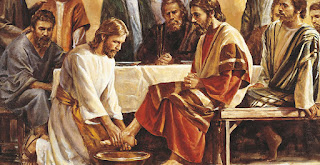
So, why did people need their feet washed in the ancient world?  They wore open, sandal-like shoes and their feet would become covered with dirt, dust, and probably refuse. It would have been really nice to have that washed away. It was considered an act of humility to wash someone else's feet. In the New Testament, Jesus washed his disciples feet just before he was betrayed.  When Peter didn't want the Lord to wash his feet, Jesus said, "If I wash thee not, thou hast no part with me."  

Why was it so important for Jesus to wash his disciple's feet? (John 13: 8) Of course, by washing his disciple's feet, Jesus taught the importance of humility and service.  There may have also been a symbolic meaning. We learn in Genesis that "dust" is a symbol of fallen man (Gen 3:19).  Just as Jesus, by humbling himself, cleansed his disciple's feet from dust, He would later that night, by humbling himself before his father, cleanse their sins through the atonement, remove from them the consequences of the fall, and enable them to eventually stand in the "holy place."

It, therefore, seems pretty fitting for the passage in Psalms 24:4 to read, 

Who shall ascend into the hill of the Lord?
or who shall stand in this holy place?
He that hath clean feet, and a pure heart.

How would they become clean? Through Jesus' willingness to humble himself enough to make them clean.


Sunday, March 21, 2021

Blessing and Knees

 Every languague uses different body parts to symbolize things.  Some of these are common across many languages, and others are different from one culture to another.  Hebrew has its own set, and I will discuss them as I come across them in my studies.  

The first one I came across was knees. In English we may say someone goes "weak in the knees" to indicate they are so overcome with emotions that they might faint.  Recently "To take a knee" has meant someone decides to respectfully not show respect for something. 

In Hebrew, the knee is related to blessing. The word to for "to kneel" is the same as to bless, baruch רך

That is why, in Hebrew, the Lord can bless us, as in the Priestly Blessing in Number 6:23

            May the Lord bless you and keep you...

And we can "bless" the Lord, as in Psalm 103:1

            Bless the Lord, oh my soul...

In both passages the word "bless" is a form of the same word, רך

One might ask, how can we as mere mortals "bless" the Lord? We can't really do anything to give him something he doesn't already have.  But if we understand that "bless" means "kneel before" that makes sense. 

But wait?  Does it make sense that the Lord would then kneel before us?  I don't know how Jewish people feel about this idea, but as members of the Church of Jesus Christ of Latter-day Saints, we know that the Lord, who is יהוה Yaweh, (see my blog post on the tetragramton) is the same as Jesus.  Was there any time that he knelt before his followers?  Yes! He knelt when he washed the disciples feet, and when he prayed for the children at Bountiful in the Book of Mormon. In the Garden of Gethsemane, he didn't kneel, but was so overcome he lay prostrate, face down, on the ground.

If יהוה who created the earth and is our Savior, was willing to kneel for us, shouldn't we be all the more willing to kneel before him?