About Me

I am a retired librarian, a member of the Church of Jesus Christ of Latter Day Saints, and an amature scriptorian. I studied Latin and Greek in college and am now trying to learn biblical Hebrew. This blog is just a place for me to record my ideas about scriptures I am studying

Sunday, April 17, 2022

Easter

This week we took a break from reading Exodus to celebrate Easter.  David and I decided to read the account from Matthew.  I also put together a little Easter gift for my neighbor who has small children. It was a version of the Easter Week activities we used to do when our kids were little.  I thought I would just include that here as it might be useful to someone. For each day there is a symbol, a scripture and an activity.

Easter Week for Little Kids

Monday: coin

On the first day of Holy Week Jesus road a donkey into Jerusalem.  Then he went to the temple and overturned the tables of the money changers.  Can you imagine all the coins spilled all over the floor? Jesus loved his Heavenly Father and wanted the temple, his “Father’s House” to be sacred and holy.

(Matthew 21: 12-13)

(donkey piñata)

 Tuesday: fig

When Jesus entered Jerusalem, he saw a fig tree that had lots of leaves but didn’t have any fruit.  In Jesus’s day there wasn’t any candy like we know it.  Figs were one of the sweetest things they had could eat. Maybe Jesus felt like the Jews of his day were like the fig tree.  They pretended to be good to show off, but they didn’t “bring forth fruit” by keeping the most important commandments. (Matthew 21: 19-21)

(fig newtons)

 Wednesday: light

Jesus taught many parables during the last week of his life on earth.  One of them was about 10 young women who were waiting for a wedding to start.  Some had brought extra oil to burn in their lamps, and some had not.  When it was time for the wedding to start, the ones who had brought extra oil filled their lamps and joined all the people walking into the wedding party.  Those that didn’t have extra oil, had to go and buy some and by the time they came back the gates to the party were already closed and they couldn’t get in.  If Jesus were telling this parable today he would have probably talked about flash lights and batteries.  We need to keep our batteries of faith charged by reading our scriptures, saying our prayers and being kind to others.  (Matt 25: 1-13)

(read our scriptures by flashlight)

 Thursday: unleavened bread

On Thursday Jesus invited his disciples to join him in celebrating the Passover.  During the Passover Jews don’t eat any bread that contains yeast.  This “unleavened bread” is a little bit like crackers.  After he kept the Passover, the told the discipled that the bread and wine used in the Passover really represented his body and blood that he would give for them.  Taking the sacrament each week reminds us of the same thing! (Matthew 26: 26-28)

(do the children’s sedar, or just eat crackers and grape juice)

Friday: love

On Friday Jesus was taken by the Roman soldiers and hung on the cross until he died.  This seems like a terrible thing but it was a way for Heavenly Father and Jesus to show their love for us. Jesus died for us so that we could someday live again with him. John, one of Jesus’ disciples said, “For God so loved the world that he gave is only begotten son, that whosoever believeth in him should not perish, but have everlasting life.” (John 3:16)

(Make heart-shaped cookies)

Saturday: key

On Saturday while his body lay in the tomb, Jesus’ spirit went and visited people in the Spirit world.  He arranged for people to go and preach to those who were in Spirit Prison.  Jesus’ sacrifice unlocked the chains of death and allowed those who are captives of sin to go free through repentance. (D&C 138:28-30)

(Easter Egg Hunt: represents the pagan side of Easter, or Easter without/Christ)

Sunday: empty

On Sunday morning some of Jesus’ disciples went to the place where they had put Jesus’ body, and found the tomb empty. Where had he gone?  His spirit and body had been reunited and he returned to Heavenly Father. He came back to tell his disciples the good news-- because he died for us we will someday be resurrected like he is and live with Heavenly Father again. (Matthew 28:5-7)

(I always gave each person some new piece of clothing for Easter Sunday.  When we were poor it might only be a tie, or new socks instead of a whole outfil. Putting on new clothes was like Jesus putting on his new resurrected body.)


Sunday, April 10, 2022

Finding Jesus in the Exodus

 When Cleopus and the other disciple were on the road to Emmaus, the resurected Jesus joined them and talked to them.  They were trying to understand Jesus' death and resurrection, and "Beginning at Moses and all the prophets, he expounded unto them in all the scriptures the things concerning himself." (Luke 24:27).  I had often wondered what he talked to them about, since I had a hard time seeing the wrathful Jehovah as the compassionate Jesus. This time, though, as I have been going through the Old Testament and taking a deeper dive into my studies, I keep seeing Jesus all over the place.  There is hardly anything in the story of the Exodus that isn't a symbol of Jesus and the plan of salvation.  Here are a few

The killing of the Lamb at the passover=Jesus death saving us from death.

Crossing the Red Sea=Through baptism, our sins are washed away, like the evil Egptians, and we start a new life leading to the presence of the Lord.  

Mana=Jesus is the bread of life that came from heaven

The water from the rock=Jesus is the living water, flowing unto eternal life

The Quail=Jesus told his deciples that they must eat of his flesh and drink of his blood.

I could go on and on.  It is really an amazing story.  Once you see it, then as you read the New Testament, you can see that the New Testament authors puposefully refer back to the Exodus story in the detail they include in their narrative.

But there was a reference to Jesus that literally took my breath away this week. 

Each week I choose one chapter from the Come Follow Me reading to read through in Hebrew.  This week I chose Exodus 15, which contains the "Song of the Sea".  It is a song that was sung by Moses and Miriam after the Egyptians were swallowed up in the Red Sea.  A couple of the podcasts I listened to mentioned that this song is probably one of the oldest texts in the Old Testament.  Or in otherwords, as the scribes were recording the story of the Exodus, they took an old, pre-existing, liturgical poem and inserted into the narrative. As I started working through it, I could tell it was written in a different style than the rest of the text.  For one thing, it calls God, El instead of Elohim, and the Lord, Ya, instead of Yaweh. Then I got to verse 2 and read 

ﬠזּי וזמרת יה ויזי לי לישׁוּﬠה

The King James translation is"The Lord is my strengh and my song, and he has become my salvation"

But in Hebrew the word "Lord" is really Ya, or what later became Yaweh, and the word for "salvation" is Jeshua.  Jeshua is the Hebrew name for Jesus.  So it really says, "Yaweh is my strength and my song, and he has become my Jesus".  When I read that, my mind kind of exploded.  Here is the most ancient text of the Pentateuch, and it says, Yaweh has become Jesus. What would it have been like for Mary when the angel told her that she would have a child and his name would be Jeshua?  She would have known this "song."  They would have read it or maybe even sung it every year during passover.  It would have been as well known to her as "Silent Night" is to us.  Did she instantly make the connection?  Did she know that her son would fulfill this thousands of years old prophecy?  I think, by the spirit, she did. 

No wonder Jesus said, "Search the scriptures for in them ye think ye have eternal life, and they are they which testify of me."  (John 5:39). They really do.


Sunday, April 3, 2022

Exodus 7-13: Moses before Pharaoh

 Once again, this passage has so much in it! The story of the Exodus is perhaps the most important story of the Old Testament, especially to the Jews.  I could try to a four -old interpretation of it, but that might turn out to be a book rather than a blog post.  So, here are a just few things that stood out to me this week.

The plagues=smack-down of Egyptian Gods

One new idea this week was from Andrew Skinner on the Follow Him podcast.  He talked about how many of the 10 plagues the Lord inflicted on Egypt through Moses and Aaron were targeted at specific Egyptian gods.  For example:

Aaron's staff-snake eating up Pharaoh's staff-snakes: The snake is one of the personal symbols of Pharaoh. Remember how Pharaoh's crown has a snake on it?  One might ask why the Lord asked Moses to do the staff-snake trick first when He knew that Pharaoh's magicians could do the same trick.  It was because he wanted Moses' snake to eat Pharaoh's snakes as a foreshadowing of the ultimate outcome of this confrontation.

The the Nile to Blood: The Nile was also considered a deity in the Egyptian pantheon. The cursing of the Nile was also a foreshadowing of when the Egyptians would be swallowed up in the Red Sea later in the story.

The frogs, the killing of livestock, destroying crops, and the swarms of insects:  There are Egyptian gods with frog heads, cattle heads, gods of the harvest and even an insect god, the Scarab Beetle.  The message is "our God is greater than your gods"

The Darkness: the highest god in the Egyptian Pantheon was Ra.  He was the creator god and the sun god.  When God, in his penultimate curse, darkened the sky, he was showing his dominance over the most powerful Egyptian god. 

There may be more, but these were the most obvious to me.


Crucifixion Imagery
The other thing that struck me this week was how the New Testament writers were very concious of the Old Testament when they wrote the account of the crucifixion. They clearly saw it as the manifestation of the symbols of the Passover.  There are tons of parallels, but two small details struck me, both surrounding the blood that was put on the doorposts of the houses of the Hebrews so that they would be saved from death.  They were supposed to kill a lamb, and use a hyssop branch to put the blood on the top and sides of the door.  This always seemed like a really gruesome and random thing to ask them to do.  But if you think about the visual image, and then think about the crucifixion it, all of a sudden, becomes the same image.  The question is, where is the blood.  When Jesus was crucified, the blood was coming from his feet, his hands, and his head, from the crown of thorns.  That's where the blood in the Passover would have been as well.  On the floor, because that is where they would have slaughtered the lamb, and then at the sides, and across the top, because that is where they had to put it with the hyssop branch. 

I think it is no coincidence that, in John 19:29, when Jesus asked for a drink as he hung on the cross, the soldiers dipped a hyssop branch in sour wine and lifted it to his lips. It is the same visual image; lifting the reddened hyssop branch up. The New Testament writers, especially John, was clearly saying, "Look, this is what you have been celebrating every year at the Passover.  This is the Lamb of God who was sacrificed to save us from Death, and the captivity of sin."  


Sunday, March 27, 2022

Exodus 1-6

 The story of Moses is so familiar it is difficult to gain new insights about it.  I listened to several different podcasts about the reading this week, and here are just a few of the comments that I found interesting. 

Moses' Ark

When we talk about the ark we usually think about Noah's Ark. In this story an ark, or תבת, shows up again, but this time it is child sized.  Just as Noah covered his ark with pitch, Jochebed covers her ark with slime and pitch to make it water proof.  It is set adrift on the waters, commended to God. Like Noah's ark, this one holds the head of a new dispensation, the beginning of a new covenant era. I think the paralells are intentional.  The editors are using symbols to communicate something about God's relationship to man and His role in the destiny of his chosen people.  I was also touched by one of the commentators that talked about how all mothers are like Jochebed.  We bring forth and nourish our children for a short while, and then send them out into an uncertain world.  We hope, when we do, that we have done a good enough job creating a spiritual ark for them that will carry them safely through into their new life. 

Moses' Character

Another podcaster talked about Moses' compassionate character. Moses initially got into trouble in Egypt because he was defending a Hebrew slave against an Egyptian. Later when he comes across Jethro's daughters having trouble defending their flocks at a well, he jumps in and helps there, too. Finally, when he talks with the Lord through the burning bush, he is clearly uncomfortable with the idea of returning to Egypt to free the children of Israel, but after the Lord gives him some assuances, he agrees to go.  Even though he was raised in Pharaoh's palace, somewhere he learned compassion.

Some number symbols

In this story we have a lot of occurances of the symbolic numbers forty and seven.  Forty is a number that represents "a lot".  Seven is a number that signifies completeness.  When the house of Israel comes into Egypt at the time of Joseph, there are 70 people who come, or in other words, all the house of Israel at the time. The Priest of Midian had seven daughters, a complete family.  Moses dwelt in Midian for 40 years, or a long time. The House of Israel had been in bondage 400 years, a very long time.  

The Women

There are not a lot of women mentioned in the Bible, so it is remarkable that women play a big part in the Moses story.  First with have the two midwifes, Shiphrah and Puah, who defy Pharaoh by refusing to kill the male infants.  Then there is Jochebed, Moses' mother, and Miriam, his sister, who help Moses survive and find his way to Pharaoh's daughter. Finally, there is Zipporah, Moses' wife, who saves Moses from the wrath of the Lord by circumsizing their son.  All of these women played essential roles in Moses' success. Later, Miriam, Moses' sister, becomes a priestess and plays an important role in the exodus. Zipporah and Jochebed also have roles to play later. I watched a short YouTube video about the roles of women in Egyptian society.  Women had more rights in Egypt than in many other contemporary civilizations.  When women married in Egypt, they kept control of their dowery assets during their marriage, and if there was a divorce, the woman would take her pocessions with her when she left.  Maybe the more progressive role of women in Egypt rubbed off on the Israelites. I also find it interesting that at the end of Exodus 3, it is the women who are asked to get the treasure from Egypt.  They are specifically asked to ask of their masters to have gold, silver and cloths, and they would give them.  It makes me think, what would have happened if the men had been given this job? How would they have handled it.  


Sunday, March 20, 2022

Joseph: a Four-fold Interpretation, Part 2

 The Joseph story is such an important part of the Pentateuch that I am doing a four-fold interpretation of is.  Last week I did the first and second types of interpretation.  This week I will do the 3rd and 4th, which I think are, if not more uplifting, at least more novel to me.

3. Context. This is the area that I learned the most about this time through the story.  Let's think again when this story was compiled into a cannon.  It was during or shortly after the Babylonian captivity.  The editors were arranging and composing the history of the House of Israeal intenionally. So, what message where they trying to get across with this narrative?  You must remember that the House of Israel had split into two groups, the North that contained Joseph's descendants through the tribes of Ephraim and Manasseh, and the south that continued the tribes if Judah and Benjamin.  So what does the story say about the two groups?  As I read the stories this time, I came to recognize that a reader could see either Joseph or Judah as the main character and savior of the House of Israel.  Sure, it was Joseph who went into Egypt, set up the system to conserve grain during the plentiful years, and kept his family and all the rest of the people from starving during the years of famine.  But it was Judah who decided to send Joseph to Egypt instead of killing him as his brothers wanted.  Later, it was Judah that offered himself as a substitute when the silver cup was found in Benjamin's bag, and Benjamin was condemned to be Joseph's servant for all time.  It was Judah's offer that convinced Joseph to reveal himself to his brothers and, arguably, to bring the whole family into Egypt, preserving them from starvation. Either group, the north or the south, could see this story as an example of how past enemies could be reconciled, and brothers be reunited. It could also be a story for either group about how hardship and captivity can ultimately end in the fullfiling of promised blessings and prosperity.  

4. Secret or Sacred.  These chapters have a lot to say about birthright.  Who, in the end, was the birthright son?  Ruben was supposed to be the birthright son, but he lost his birthright because he slept with his father's concubine.  It could have passed from there to Simeon, the second born, or it could pass to Joseph, as first born of the second wife.  The blessings given to Ephraim and Manasseh seem to indicate the latter. It is significant that Jacob adopts Ephraim and Manasseh and gives them blessings equivalent to their uncles.  Traditionally, status as a Jew comes through the mother.  If your mother is a Jew, you are a Jew, but if she is not, you are not.  This makes sense since maternity is much easier to establish than paternity.  Ephraim and Manasseh, however were born of an Egyptian mother.  They, therefore, would not have been considered as members of the Abrahamic covenant if they had not been adopted into the covenant.  This has significance for the members of the Church of Jesus Christ of Latter-Day Saints.  When members of the Church receive their patriarchal blessings, they usually are adopted into or declared as descendants of the tribes of Ephraim or Manasseh.  It is fitting that we, who are gentiles by birth, should be part of the tribes of Ephraim and Manasseh, who were also gentiles, adopted into the covenant.  If these two boys were not only adopted into the tribes, but were actually named the birthright sons, this symbolizes the great responsibly we have to be stewards and caregivers over all the House of Israel in the modern day. 


Sunday, March 13, 2022

Joseph:a Four-fold Interpretation, Part 1

 I don't know if there is any story from the Old Testament that has been more studied and written about than the story of Joseph, son of Jacob.  I have really enjoyed learning more about this story this week and look forward to reading and studying its conclusion next week.  There is so much here, I can easily imagine writing a whole book on the topic, so I have been struggling to figure out what to write in my blog, where I only have about one page.  I decided to take a quick four-fold interpretation of the story.  Just as a reminder, this it is a method developed by Jewish scholars that follows an acronym for the word that means paradise. דספר

 פ= Peshat =פשט =literal

ר=Remez= רמז=symbolic

ד=Drash= דרש=context

ס=Sod =סוד =secret or sacred

I may only get through two of these interpretations today, and do the other two next week.

1. Literal:  When you take the story of Joseph on a literal level you find a beautiful example of family drama, faith, overcoming trials, and forgiveness.  Joseph is the son of Jacob's favorite wife and seems to be his father's favorite as well. This makes his older brothers jealous. Their jealousy turns to hatred when he tattletails on them to his father, and when he tells them his dreams that seem to suggest that he will one day rule over, not only his brothers, but his parents as well. His brothers, who have already shown their willingness to kill for their honor in the bloody revenge they took for Dinah's rape, decide to kill Joseph and make it appear to their father that he was killed by wild beasts.  At the last minute the oldest, Ruben, intervines, and save's Joseph's life, but his other brothers contrive to sell him as a slave instead. Joseph becomes a slave to Potiphar, an Egyptian military leader, where he prospers.  This prosperity comes to an end when Potiphar's wife propositions Joseph, and then accuses him of sexual harrassment.  Joseph is once again brought low, only to rise again by interpreting Pharaoh's dream.  He becomes the second in power in all Egypt by coming up with a plan to save Egypt from famine. The most tender part of the story comes when Joseph's brothers come to Egypt asking for food.  They don't, at first recognize Joseph.  Joseph interrogates them and assertains that they have regretted what they did to him. He frankly forgives them for their past wrongs and acknowleges God's hand in putting him in a position to save his family and all the land from famine.  If you only read the story on this level, you will finish uplifted and encouraged to live a more patient and forgiving life.

2. Symbolic: Christians see the story of Joseph as a type of the life of Jesus Christ.  The similarities of their two lives are numerous and striking.  It is maybe easiest to list them 

Miraculous birth (Rachel was baren for a long time before having Joseph)
Favorite son of his father, destined to rule over all the other sons
Joseph's time in Egypt is seen as equivalent to Jesus' sojourn on the Earth.
          Rejected by his own kinsmen and turned over to strangers 
False accusations and time spent in prison
Forgiving those who wanted to take his life.
Saviour of the people (Joseph physically, Jesus spiritually)

There are more than this.  One of the podcasts I listen to said that there was an early Christian scholar who found 18 similarities.  I think writers of the gospels purposely pointed out similarities between Jesus' life and Joseph's. 

These two interpretations are pretty widely held.  I will get into some more, less discussed perspectives on the story next week.


Sunday, March 6, 2022

Jacob's Faith Journey

When we talk of the patriarchs, we talk of Abraham, Isaac and Jacob.  As I already discussed, Abraham is portrayed as the ideal faithful follower.  We actually don't hear a lot about Isaac's faith journey. He seemed to have walked in obedience and faith from the beginning, always building alters and digging wells, both forms of covenant worship.

We do hear a lot about Jacob's faith journey.  It started before he was born.  In Genesis 25:22-23 Rebekah prays about her pregnancy and is told that she is carrying twins, and that "the elder shall serve the younger."  In Jacob's early years he seems to have been guided primarily by his mother.  The text states that Jacob was Rebekah's favorite (Gen 25:28) but the reader is left to wonder how much Rebekah told Jacob about her revelation about his destiny.  We do know that when Jacob has food and Esau is hungry, Jacob suggests that Esau sell his birthright to get food (Gen 25:31-33). Later when it is time for Isaac to pass on covenant blessings to his eldest son, Rebekah convinces Jacob to deceive Isaac and obtain the blessing instead, thus fulfilling, she thought, her revelation about Jacob.

The result of Jacob following his mother's direction to deceive his father, was that, to avoid Esau's revenge, Jacob had to leave his parents to find refuge, and a wife, among extended family. Before he left, Isaac blessed him with all the blessings of the Abrahamic covenant (Gen 28:3-4). This is another example of faith coming from a parent, this time his father. 

It wasn't until Jacob started traveling toward Haran that he had his own revelatory experience. He had a dream of the Lord confirming the promises Isaac had pronounced upon him before he left (Gen 28: 12-15).  In the revelation, the Lord didn't mention that he required anything from Jacob. When Jacob woke up he recognized that he was in a sacred space (Gen 28:16) and he built a monument to his experience there (28:18).  He didn't, however, at that time, fully accept the Lord as his god.  He made a vow to the Lord, but it was conditional. "If God be with me, and will keep me in this way that I go, and will give me bread to eat, and raiment to put on, so that I come again to my father's house in peace; then shall the Lord be my God" (Gen 28:20-21). 

Jacob goes on to Haran, and meets Laban, Rachel, and Leah.  In an ironic twist of fate, Laban deceives him into honoring birth order (which Jacob had defied) and marrying Leah before Rachel.  Jacob toils for many years for Laban.  Presumably, Esau stays at home and enjoys, in the absence of his rival, if not the actual birthright, the effectual benefit of a firstborn son. Jacob seems to be humbled by his years in service.  As he becomes more humble and submissive, both to Laban, his wives, and the Lord, his flocks and progeny grows. 

After Jacob has worked for Laban for 20 years, the Lord appears to him and shows him that He had kept most of his end of the bargain.  The Lord led him to Haran and prospered him there. The Lord tells him that it is time to do the last thing in the bargain, which was to return to the home of his father in peace. (Gen 31:13)  Jacob is nervous about this.  He is worried about what Laban will do when he tries to leave and what Esau will do when he arrives at home. The Lord takes care of the first concern.  Laban is pacified by a dream (Gen 31:24) so he eventually lets Jacob go in peace (Gen 31:55).

Jacob is about to face his final, and it seems his most dangerous trial, facing Esau.  As he is about to face his brother, and his brother's army of 400, Jacob says a prayer that shows that he has finally developed faith in God, and true humility. He prays "I am not worthy of the least of all the mercies, and of all the truth, which thou hast shewed unto they servant." (Gen 32:10)  It is when Jacob reaches this place of humility and submission (symbolized in wrestle with the angel and breaking of his hip, Gen 33:28) that he becomes a new person, a heir of the covenant.  The Lord commemorates Jacob's acceptance of the covenant by changing his name from Jacob, which means Supplanter, to Israel, which means Let God Prevail. (Gen 32:38)

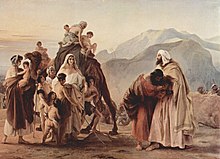
It is interesting that Jacob's reunion with Esau comes after his experience with the angel.  One of the podcasters I listen to compared Jacob's embrace with Esau to God's embrace when we pass through the veil into immortality.  Jacob had wronged Esau and was cast out from his presence. In order to return to his brother, he humbled himself, sacrificed all he had, and begged for forgiveness.  Esau, like the Lord, accepted Jacob's offering and received him back into full fellowship.

There is one more account of Jacob's faith journey that brings it full circle. In Genesis 34 there is an account where Dinah is raped by men of a neighboring tribe.  Her two biggest brothers, Ruben and Levi, retaliate by tricking and then slaying the perpetrators and ravaging their village.  Jacob recognizes this as a great sin.  The Lord, in chapter 35, commands Jacob to take  his family back to Beth-el (the place of his covenant with the Lord) and purify them and make sacrifices for them.  Jacob started out relying on the faith of his parents, and now he has become the parent, taking upon himself the responsibility of passing on his faith tradition to his sons. 

So we have the faith journey of Jacob.  It starts by him relying on his parent's faith.  Then he comes to recognize the existence of God, but puts conditions on him--you grant me this and I will acknowledge you as my god. Over time, Jacob humbles himself completely, repents of his sins, offers all he has, and is accepted back into God's symbolic embrace.  Then he takes upon himself the role of the parent who is passing on his faith tradition to the next generation.